
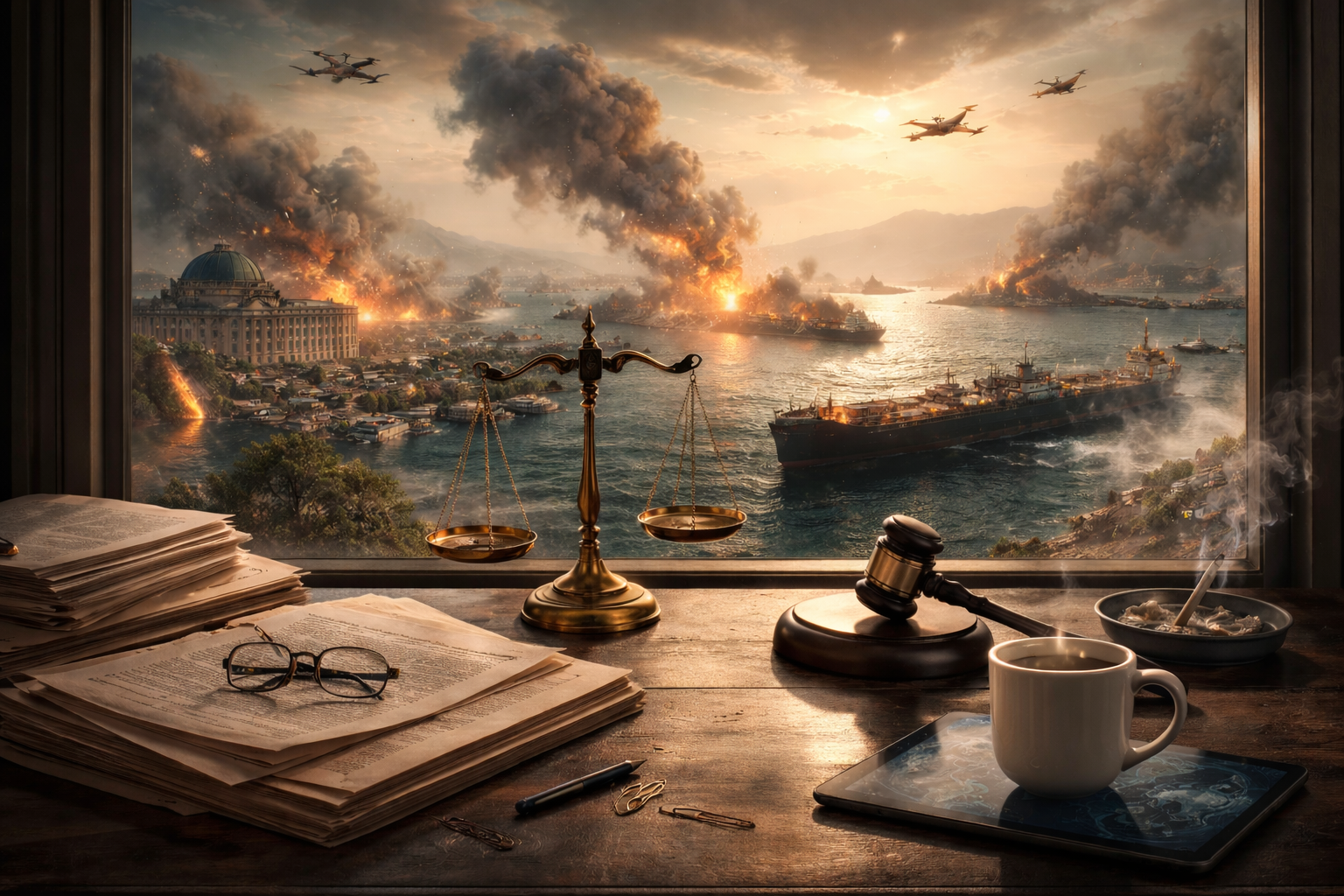
There are moments in history when the world becomes so implausible that even lawyers , a profession not exactly famed for whimsy , are forced to admit that reality has begun to outcompete satire.
And….we appear to be living through one of those moments.
- A widening conflict involving Iran.
- Renewed panic over the Strait of Hormuz.
- A major German parliamentary inquiry into COVID governance and vaccine-era decision-making.
- Continued international fragmentation over speech, censorship, surveillance, energy security, public health, military escalation, and state secrecy.
And through it all, governments, corporations and public institutions continue to speak in that same reassuring managerial dialect which, when translated into plain English, usually means: we are improvising wildly and hope you do not request disclosure.
The legal profession, unlike the public relations profession, has the unfortunate burden of taking things literally. That means asking unfashionable questions such as: who has the power to do what, under what authority, with what consequences, and who will ultimately carry the loss when the slogans run out and the invoices arrive.
That is where things become interesting.
Because if recent world events have taught us anything, it is this: truth is not only stranger than fiction , it is usually buried under six press releases, three emergency directives, and a heavily redacted annexure marked “confidential.”
The Iran Question: When Geopolitics Becomes a Commercial Liability Event
The renewed volatility around Iran has not merely revived familiar geopolitical anxieties. It has also reminded the world of something commercial lawyers, insurers and shipping interests have always known: a military crisis in the Gulf is not just a foreign policy story. It is a contracts, risk allocation, sanctions and insurance story wearing camouflage.
This is particularly true in relation to the Strait of Hormuz , a narrow maritime artery through which a significant share of the world’s oil and gas supply passes. Whenever tensions rise there, markets behave as though they have suddenly rediscovered the concept of geography, and legal departments begin revisiting clauses they have not looked at since the last regional panic.
For businesses, the issue is not simply whether a route is physically open. It is whether it remains commercially and legally viable.
That distinction matters.
A shipping lane can remain technically navigable while becoming practically unusable due to war-risk premiums, insurer hesitation, sanctions exposure, cargo insecurity, crew safety concerns, charterparty disputes, and lender anxiety. In other words, one does not need a formal blockade to produce the same effect. One needs only enough instability to make ordinary trade irrational.
That is the genius of modern disruption: it rarely arrives in the form of an official declaration; it arrives as legal uncertainty with a body count.
And uncertainty, as ever, is billable.
The Strait of Hormuz: Not a Canal, But Certainly a Trap
There is something almost offensive about how much of the global economy depends on a narrow body of water that sounds like it should either be a minor Greek island or an expensive skincare ingredient.
Yet here we are.
The Strait of Hormuz is not merely a shipping route. It is a stress test for international law, marine insurance, sovereign power, and everyone’s ability to keep a straight face while pretending the phrase freedom of navigation has the same meaning in peacetime as it does when regional actors are behaving like men in an inheritance dispute with missiles.
In legal terms, chokepoints such as Hormuz expose the fragility of the assumptions upon which international commerce rests. We like to imagine that trade is governed by systems, conventions and predictable rules. In reality, much of it is governed by the hope that no one sufficiently armed and sufficiently irritated decides to reinterpret the situation before lunch.
Once that happens, all the elegant architecture of global commerce begins to look less like a durable legal order and more like a gentleman’s agreement held together by insurers in London and caffeine in Singapore.
This is where the law becomes deeply practical. Questions arise immediately:
Can force majeure be invoked?
Has frustration occurred?
Do sanctions clauses permit termination?
Does a change in political or military conditions excuse delayed performance?
What if a vessel is diverted, detained, reclassified, uninsured, or simply too expensive to move?
These are not theoretical curiosities. These are the things that determine whether a company survives the quarter.
Germany’s COVID Inquiry: The Awkward Return of Questions That Were Supposed to Stay Dead
If the Gulf represents one kind of institutional stress, Germany’s inquiry into COVID governance represents another: the legal afterlife of emergency power.
For several years, much of the democratic world operated under a peculiar arrangement in which governments, regulators, pharmaceutical actors, public health bodies, media institutions and technology platforms all seemed to agree that the public could be trusted to comply, but not necessarily trusted to know.
This, in retrospect, was not ideal.
Now that Germany has moved to formally examine aspects of pandemic governance, vaccine-era policy, and institutional decision-making, one senses the quiet return of a concept that had become unfashionable during the height of the crisis: accountability.
A dangerous idea, apparently.
To be clear, serious inquiry is not evidence of anti-scientific hysteria. On the contrary, it is the hallmark of a functioning constitutional order. If governments relied upon emergency powers, restricted ordinary liberties, accelerated regulatory approvals, entered major procurement arrangements, and materially shaped public discourse, then the public is entitled , indeed obliged , to ask what was done, on what basis, and with what degree of candour.
That should not be controversial. Yet somehow, in our age, it often is.
And that is precisely why the law matters.
Because while politics is often content to move on once the emotional weather changes, law is one of the few disciplines still rude enough to ask for minutes, correspondence, procurement records, advisory notes, indemnities, risk assessments and unredacted drafts.
In other words: law is what happens when memory acquires subpoena power.
The Modern State’s Favourite Hobby: Saying “Trust Us” in Twelve Different Fonts
One of the most remarkable features of recent global governance has been the sheer quantity of matters in respect of which the public has been expected to display immediate obedience and delayed curiosity.
- Trust us about the war.
- Trust us about the sanctions.
- Trust us about the emergency.
- Trust us about the vaccine.
- Trust us about the supply chain.
- Trust us about the intelligence.
- Trust us about the surveillance.
- Trust us about the redactions.
- Trust us about why the people who were wrong keep being promoted.
There is, to put it mildly, a pattern here.
The legal problem with excessive institutional opacity is not merely that it offends democratic sensibility. It is that opacity becomes intolerable the moment outcomes begin to look incompetent, contradictory, or suspiciously profitable.
And that is exactly where many public institutions now find themselves.
The old model of governance relied heavily on informational asymmetry: if officials and experts controlled enough of the narrative, the public could be managed through confidence rather than clarity. But that model begins to fracture once too many events start producing the same aftertaste , secrecy, retrospective qualification, shifting definitions, and a suspiciously late interest in “lessons learned.”
That phrase, incidentally, should terrify everyone.
When a government announces that it is “learning lessons,” what it usually means is that the expensive part has already happened.
Why Lawyers Should Be Paying Close Attention to “Weird” News
There is a persistent temptation among otherwise intelligent people to categorise major global absurdities as “politics,” and therefore as something adjacent to the law rather than central to it.
This is a category error.
The law does not live in a vacuum. It lives downstream of power, panic, commerce, ambition, fear, and human self-interest , which is to say, it lives precisely where the world is currently misbehaving.
- When oil routes become unstable, the law becomes relevant.
- When public health governance is re-examined, the law becomes relevant.
- When emergency powers are normalised, the law becomes relevant.
When censorship is justified as safety, when secrecy is marketed as competence, when military escalation is managed through euphemism, and when the public is told not to worry while everyone with access to a Bloomberg terminal is visibly worrying , the law becomes very relevant indeed.
Because eventually every major social absurdity becomes a file.
And once it becomes a file, someone will have to determine:
- Who owed what duty.
- Who breached what duty.
- Who made what representation.
- Who relied on it.
- Who profited.
- Who suffered loss.
- …….And who now wishes the relevant emails had remained mysteriously “unavailable.”
That is not cynicism. That is merely adulthood with document review.
The Real Legal Theme of This Era: Managed Reality
If there is one legal theme that unites the current age, it is this: we are living through an era of managed reality.
Not necessarily pure lies , that would almost be refreshingly straightforward , but something more sophisticated and more corrosive: partial truths, curated disclosures, emergency framings, selectively timed transparency, and the industrial-scale laundering of political judgment into the language of necessity.
This is why so many current events feel faintly surreal. It is not only that the events themselves are dramatic. It is that they are increasingly accompanied by narratives so tightly managed, so linguistically deodorised, and so professionally focus-grouped that one begins to miss the old-fashioned honesty of a straightforward scandal.
At least in a straightforward scandal, everyone knew where the villain was sitting.
Today, the villain often arrives in the form of a cross-functional advisory panel with a logo.
Conclusion: The Stranger the World Gets, the More the Law Matters
In calmer times, the law can appear dry, procedural, almost dull. But in periods such as this , when the world begins to resemble a collapsed border between satire and policy , the law reasserts its real purpose.
Its function is not to make humanity wise. That has never worked.
- Its function is to insist on clarity where power prefers ambiguity.
- To insist on evidence where institutions prefer narrative.
- To insist on responsibility where everyone would rather issue a statement.
- And, perhaps most importantly, to insist that extraordinary events do not permanently exempt extraordinary actors from ordinary scrutiny.
That is why lawyers, for all our defects, remain useful in an age of confusion.
Because while the rest of the world is busy saying, “Surely this cannot get any stranger,” the law is already asking the only question that matters:
Yes, but who signed it?