
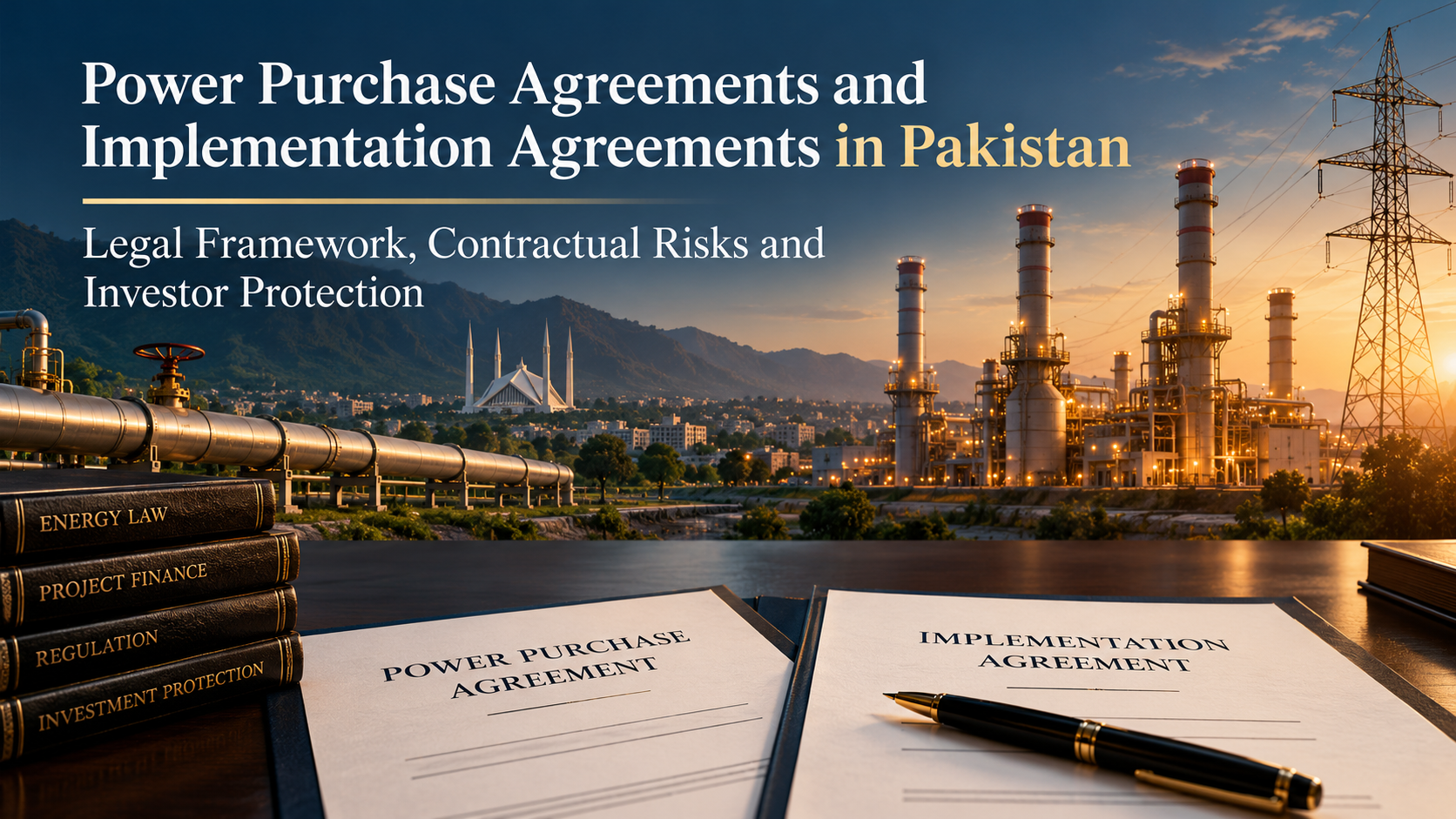
An updated legal guide to electricity procurement, oil- and gas-fired power projects, government guarantees, project finance, regulatory compliance and dispute resolution in Pakistan.
Updated: October 2026 | Josh and Mak International
Introduction
Power Purchase Agreements (PPAs) and Implementation Agreements (IAs) constitute two of the most significant contractual instruments in Pakistan’s private power generation sector. Their importance extends beyond the formal allocation of rights and obligations between an electricity producer, purchaser and governmental authority. Together with the associated financing, fuel supply, transmission and security documentation, they determine whether a power generation project is legally executable, commercially viable and capable of attracting long-term investment.
Pakistan’s electricity sector has historically depended upon a contractual structure under which independent power producers (IPPs) develop and operate generation facilities pursuant to long-term electricity purchase arrangements, commonly supported by government undertakings and carefully structured risk-allocation mechanisms.
These arrangements have evolved considerably. The Regulation of Generation, Transmission and Distribution of Electric Power Act, 1997 (the NEPRA Act), subsequent amendments, the Power Generation Policy 2015, National Electricity Policy 2021, National Electricity Plan 2023–2027 and more recent electricity-market reforms have materially influenced the environment in which power projects are developed, financed and operated.
The commencement of Pakistan’s Competitive Trading Bilateral Contract Market (CTBCM) framework in January 2026 represents a particularly important development. The movement towards greater competition, bilateral electricity trading and regulated network access requires investors to distinguish between traditional, government-supported generation projects and transactions structured under emerging competitive-market arrangements.
At the same time, the renegotiation and early termination of various IPP agreements during 2024–2026 have demonstrated that the commercial assumptions underpinning long-term power contracts may become the subject of substantial governmental, regulatory and financial scrutiny.
For investors, lenders and power developers, the central legal question is therefore not merely whether a proposed PPA or IA contains familiar contractual provisions. It is whether the entire project documentation establishes a coherent, legally enforceable and financially sustainable allocation of risk under the regulatory framework applicable to that particular project.
Understanding Power Purchase Agreements in Pakistan
A Power Purchase Agreement is a contractual arrangement governing the purchase and sale of electricity between a generating company and an authorised electricity purchaser.
In traditional IPP projects, the PPA establishes the commercial and operational relationship between the project company and the relevant power purchaser. Depending upon the applicable contractual and regulatory structure, that purchaser may be a designated public-sector electricity purchasing entity, an authorised supplier or another legally eligible purchaser.
The PPA ordinarily addresses the electricity to be supplied, the capacity to be made available, tariff arrangements, commissioning requirements, metering, payment procedures, operational obligations, liability, force majeure, termination and dispute resolution.
Its commercial significance lies in converting the generating facility’s anticipated output or capacity into an identifiable revenue stream.
However, that revenue stream must be examined alongside the applicable tariff determination, dispatch arrangements, fuel supply obligations, regulatory permissions and payment security.
A signed PPA is not, by itself, proof that a project is financially bankable.
A project may possess an apparently favourable tariff whilst remaining commercially vulnerable because of uncertain fuel supplies, insufficient payment security, delayed transmission infrastructure or contractual provisions that allocate excessive operational risks to the generating company.
Capacity Payments and Energy Payments
Historically, a significant feature of Pakistan’s thermal power arrangements has been the distinction between Capacity Purchase Price (CPP) and Energy Purchase Price (EPP).
The Power Generation Policy 2015 expressly recognises this two-part tariff structure.
The EPP principally addresses the variable costs associated with electricity actually delivered, including fuel costs and variable operation and maintenance expenses.
The CPP addresses specified fixed costs associated with making generation capacity available, including qualifying fixed operation and maintenance costs, financing obligations and returns determined within the applicable tariff framework.
Under a capacity-based arrangement, the purchaser may therefore become liable for capacity payments where the generating facility satisfies the relevant contractual availability requirements, notwithstanding that the electricity system has not dispatched the plant to its maximum available output.
This structure is materially different from an arrangement under which payment depends principally upon electricity actually delivered.
The legal distinction is particularly important because contractual references to availability, dispatch instructions, declared dependable capacity, testing, scheduled outages and deemed availability directly affect the revenue entitlement of the generating company.
The precise operation of these mechanisms depends on the applicable PPA and tariff determination. It would be incorrect to assume that every existing or future electricity purchase arrangement in Pakistan incorporates identical capacity-payment protections.
What Is an Implementation Agreement?
An Implementation Agreement is a project agreement establishing the respective rights and obligations of the project company and the Government of Pakistan, or another competent public authority acting within its lawful powers.
Unlike the PPA, which principally regulates electricity purchase and sale, the IA addresses the governmental and broader project-implementation aspects of the transaction.
Its provisions may include governmental support, regulatory facilitation, taxation, foreign exchange, political risk, security arrangements, project financing, assignment, termination compensation and dispute resolution.
An IA should not be characterised merely as a preliminary or construction-stage agreement.
The contractual obligations contained in an IA may continue throughout the operational life of the project. Governmental undertakings relating to the protection of contractual rights, certain political events, defined changes in law and termination compensation may become relevant many years after a generating facility has commenced commercial operations.
The legal value of an IA consequently depends upon the precise obligations undertaken, their duration, the circumstances in which they become enforceable and the remedies available following breach.
Government Support Is Not an Unlimited Guarantee
One of the most important distinctions in energy-sector legal practice concerns the difference between governmental support, a governmental undertaking and an enforceable sovereign guarantee.
An undertaking to facilitate regulatory approvals is not necessarily equivalent to a commitment that every approval will be issued.
Similarly, the existence of an Implementation Agreement does not automatically establish an unconditional government guarantee for every payment or liability of the power purchaser.
The scope of any governmental guarantee must be established by examining the applicable policy, executed security-package documentation, guarantee instrument, defined guaranteed obligations, conditions and exclusions.
For lenders, this distinction may be decisive.
A guarantee that is conditional, inadequately authorised or narrower than the underlying payment obligation may leave important financing risks uncovered.
The Legal and Regulatory Framework in 2026
Pakistan’s power-sector contractual arrangements operate within a combination of statutory legislation, regulatory instruments, governmental policies and project-specific contractual documentation.
The principal instruments requiring consideration include the NEPRA Act, 1997, as amended; the Private Power and Infrastructure Board Act, 2012, as amended; the Power Generation Policy 2015; the National Electricity Policy 2021; and the National Electricity Plan 2023–2027.
The applicable framework must also account for electricity licensing and concurrence requirements, technical connectivity standards, tariff determinations, market rules and the Grid Code.
In April 2026, NEPRA notified the National Electric Power Regulatory Authority (Concurrence) Regulations, 2026, through S.R.O. 692(I)/2026, together with the National Electric Power Regulatory Authority (Technical Standards for Grid Connectivity) Regulations, 2026, through S.R.O. 693(I)/2026.
These regulatory developments are relevant to the assessment of generation projects and their connection to the electricity network.
A developer should therefore ascertain whether its project is governed by an existing generation licence, requires generation concurrence under section 14B of the NEPRA Act, or is subject to another applicable approval or transitional arrangement.
The developer must also distinguish permission to generate electricity from permission to supply electricity to a customer. Generation authority does not necessarily confer an unrestricted right to undertake electricity supply activities.
The official NEPRA legislation and regulations directory provides the relevant regulatory instruments.
The Continuing Role of PPIB
The Private Power and Infrastructure Board (PPIB) has historically performed an important institutional role in facilitating private investment in power generation and associated infrastructure.
The PPIB Act, 2012, as amended in 2023, also provides the legislative basis for the institutional merger of the Alternative Energy Development Board into PPIB.
Depending on the applicable policy and project arrangement, PPIB may be involved in project processing, support documentation, coordination with public-sector entities and implementation arrangements.
Nevertheless, the existence of a general statutory mandate should not be mistaken for authority to dispense with independently applicable regulatory, procurement or financial requirements.
A legally defensible project structure must establish which institution is authorised to approve, regulate, purchase, guarantee or otherwise participate in the relevant transaction.
Which Power Policy Applies?
Pakistan has developed power projects under different policy generations, including the policies of 1994, 2002 and 2015, as well as renewable-energy and other sector-specific arrangements.
It is legally unsafe to assume that the most recently issued policy automatically replaces all contractual rights established under an earlier policy.
For an existing project, the starting point is ordinarily the policy under which it was processed, the original approval and support documents, the executed project agreements, applicable tariff decisions and subsequent amendments.
The Government’s published power-sector policy directory continues to identify multiple policy instruments.
The applicable contractual regime must therefore be established individually rather than presumed.
Why the May 2006 Standard Agreements Remain Relevant
PPIB’s historical standard documentation includes the Standardised Power Purchase Agreement for Oil/Gas Projects dated 15 May 2006 and the corresponding Standardised Implementation Agreement.
These documents remain useful for understanding the contractual architecture of traditional thermal IPP projects.
The 2006 PPA addresses matters such as construction, commissioning, interconnection, testing, capacity and energy payments, operational performance, insurance, indemnities, force majeure and dispute resolution.
The corresponding IA addresses governmental support, taxation, foreign exchange, assignment, security, political events, termination compensation, lender protections and arbitration.
Importantly, the 2006 IA already contains provisions relating to environmental liabilities and a termination-stage environmental audit, as well as detailed provisions for expert determination and arbitration.
It would consequently be inaccurate to describe these agreements as entirely lacking environmental or dispute-resolution protections.
The more appropriate legal criticism is that the adequacy of any particular clause must be assessed against the project’s circumstances, the applicable law, contemporary financing requirements and the relationship between the various project agreements.
The May 2006 documents should not be treated as universally applicable current templates or assumed to have been adopted without amendment by subsequent projects.
Certain older drafting features, including references to historical interest-rate benchmarks, also require review when existing contracts are being amended or refinanced.
Essential Provisions of a Bankable Power Purchase Agreement
1. Contractual Capacity and Performance Testing
A properly drafted PPA must distinguish installed capacity, contracted capacity, tested capacity, dependable capacity and available capacity.
These expressions may represent different technical and commercial concepts.
The agreement should identify the contractual tests by which generating performance is assessed, the consequences of failed tests and the manner in which subsequent changes in performance affect payment entitlements.
Disputes may arise where testing conditions, ambient temperature adjustments, plant degradation or testing methodologies are inadequately specified.
The agreement should also address the circumstances in which testing may be repeated and whether the parties may refer disagreements to an independent technical expert.
2. Construction, Commissioning and Commercial Operations
The construction provisions must identify the respective obligations concerning engineering, procurement, construction, permits, site access, transmission connection and commissioning.
The Commercial Operations Date (COD) is of particular importance because it may trigger the principal operational and payment regime.
A well-structured agreement should distinguish delays attributable to the project company from delays resulting from transmission infrastructure, purchaser default, governmental action or qualifying force majeure.
This distinction is essential when determining entitlement to extensions of time, liquidated damages or other contractual relief.
Delay provisions should also be reconciled with the engineering, procurement and construction contract so that the project company is not exposed to liabilities that cannot appropriately be passed through to its contractor.
3. Dispatch and Deemed Availability
A thermal power project may be technically capable of generating electricity but prevented from doing so because of dispatch restrictions, transmission constraints or purchaser-related circumstances.
The PPA should clearly identify which party bears the economic consequences of such restrictions.
Where deemed availability or comparable contractual relief is recognised, the drafting must identify the qualifying events, evidential requirements and method of calculating the resulting entitlement.
Neither deemed availability nor compensation for non-dispatch should be presumed to arise automatically.
4. Tariff Determination, Indexation and Regulatory Consistency
Electricity tariffs are central to the commercial relationship between the generating company and purchaser.
The PPA must be consistent with applicable NEPRA determinations, approved tariff components, indexation arrangements and contractual assumptions.
Particular attention should be given to inflation, foreign exchange movements, interest-rate changes, fuel-price adjustments and the consequences of refinancing.
A contractual formula that does not correspond with the applicable regulatory determination may create serious payment and enforcement difficulties.
For agreements incorporating historical benchmark interest rates, contractual amendments may also be required to ensure workable replacement mechanisms.
5. Billing, Payment Security and Circular Debt
Payment risk remains one of the defining concerns of Pakistan’s electricity sector.
The PPA should regulate the submission and verification of invoices, payment periods, disputed amounts, default interest, reconciliation and available remedies.
For a financed project, contractual payment obligations must be considered alongside the actual creditworthiness of the purchaser and the available payment-security arrangements.
The existence of sovereign support, where applicable, does not eliminate the need to examine procedural conditions, notice requirements, documentary evidence and the precise guarantee coverage.
In the context of Pakistan’s persistent circular-debt challenges, lenders may place considerable importance upon the practical operation of payment security rather than its formal existence alone.
6. Fuel Supply and Fuel Risk
For oil- and gas-fired facilities, fuel availability may be as important as electricity purchase commitments.
The PPA should be reviewed together with the relevant Gas Supply Agreement (GSA), Fuel Supply Agreement (FSA), transportation arrangements and fuel-related tariff provisions.
The documents should address fuel specifications, quantity, delivery pressure, interruptions, scheduled maintenance, curtailment, price adjustment and the consequences of insufficient supply.
Where a project depends upon imported re-gasified liquefied natural gas (RLNG), additional commercial risks may arise concerning import arrangements, terminal access, transportation capacity and the contractual treatment of supply interruptions.
Fuel risk should not be allocated in one agreement without considering the corresponding rights and obligations contained in the other project documents.
7. Interconnection and Transmission Infrastructure
A generation facility cannot produce its intended commercial revenues unless electricity can reach the designated delivery point through an appropriate network arrangement.
The allocation of responsibility for interconnection works, network reinforcement, testing, maintenance, metering and transmission availability must therefore be settled with precision.
The project documentation should also address delay caused by transmission infrastructure that is outside the developer’s control.
The absence of clear interface obligations may expose the project to simultaneous contractual disputes involving the contractor, power purchaser and transmission entity.
8. Change in Law
Long-term infrastructure investments are exposed to the possibility of legislative and regulatory changes during their operational lives.
Change-in-law clauses should establish the relevant baseline date, qualifying changes, materiality thresholds, notification procedures and available economic relief.
Particular care is required to distinguish generally applicable legislative changes from project-specific regulatory decisions, changes in tax treatment and amendments that fall within risks expressly assumed by the developer.
A change-in-law clause should not be drafted as an unrestricted entitlement to recover every additional business expense.
Equally, a mechanism that excludes material and unforeseeable governmental changes may place a disproportionate burden upon the project company.
The appropriate allocation depends upon the governing policy, procurement terms, regulatory approvals and negotiated risk structure.
Oil and Gas Supply Agreements: An Important Legal Distinction
The expression “oil and gas power purchase agreement” can sometimes cause confusion.
A PPA concerns the sale and purchase of electricity, even where that electricity is generated from natural gas, furnace oil or another petroleum-derived fuel.
The sale and purchase of natural gas is ordinarily governed by a separate gas-sale or gas-supply arrangement.
Upstream petroleum rights are also distinct from electricity generation rights.
An oil and gas exploration company does not acquire an unrestricted right to establish and sell electricity merely by holding a petroleum exploration licence or production lease.
These activities may involve separate regulatory, contractual and corporate requirements.
Pakistan’s upstream petroleum arrangements are governed by the applicable petroleum legislation, concession agreements, production-sharing arrangements and the Petroleum Exploration and Production Policy 2012, as amended.
The March 2024 amendments to the Petroleum Exploration and Production Policy 2012 contain significant provisions concerning the sale of specified natural-gas production to third parties, subject to their conditions and applicability.
Those provisions should not be interpreted as conferring an unconditional right to sell gas or electricity free from the requirements of other laws.
Where a proposed gas-fired project depends upon independently procured gas, particular attention must be given to the legal entitlement to purchase and transport that gas, the identity and licensing status of the supplier, network access, gas specifications and applicable charges.
The Oil and Gas Regulatory Authority (OGRA) administers an important part of the relevant downstream framework, including the OGRA Gas (Third Party Access) Rules, 2018 and the Pakistan Gas Network Code.
OGRA’s published regulatory materials include a Gas Network Code dated 17 July 2026.
For a gas-dependent project, the legal architecture of the fuel supply should therefore be examined independently before the power sales arrangement is treated as commercially secure.
Government Guarantees, Political Risk and Investor Protection
Government-backed power projects frequently involve complex interactions between public-sector support, lender protections and sovereign obligations.
The legal analysis must identify the precise government entity undertaking each obligation and whether that entity possesses the statutory authority to do so.
The project company should establish whether the relevant undertakings are contractual obligations, policy statements, administrative commitments or separately guaranteed liabilities.
The distinction is important because an investor may otherwise assume that an expression of governmental support creates enforceable financial recourse where the executed documentation provides no such remedy.
Political-risk provisions should also distinguish between direct governmental interference, discriminatory measures, expropriation, qualifying changes in law and ordinary commercial or regulatory risks.
The available remedies may differ materially.
For foreign investors, the project structure should additionally consider applicable investment-protection arrangements, taxation agreements, foreign exchange legislation, repatriation requirements and the enforceability of any arbitration agreement.
Such protections must be assessed according to the investor’s nationality, investment structure, applicable treaty and particular governmental conduct. They should not be presumed to exist merely because the project involves foreign capital.
Project Finance and Lender Step-In Rights
Power generation projects are frequently financed through substantial debt arrangements extending over many years.
Lenders accordingly require contractual protections that go beyond the generating company’s ordinary rights under a PPA.
These may include assignment of project receivables, security over project assets, direct agreements, notice of defaults, cure periods and lender step-in or substitution rights.
One of the central issues in project finance is whether a default by the project company can result in immediate termination before lenders have a meaningful opportunity to protect their investment.
A carefully structured security package should identify which defaults are capable of cure, the circumstances in which the lenders may intervene and the procedure for substituting a qualified replacement project company where permitted.
The PPA, IA and financing documents should also provide a consistent position concerning the application of termination proceeds and outstanding financial liabilities.
The enforceability of lender protections depends upon the executed documents and applicable Pakistani law, rather than upon the inclusion of standard terminology alone.
Termination Compensation and the Consequences of Early Termination
Termination provisions are among the most financially consequential aspects of a power project.
They should distinguish between termination caused by project-company default, purchaser default, qualifying governmental conduct, prolonged force majeure and other contractually specified events.
The consequences may involve different compensation mechanisms.
In certain traditional project structures, the relevant agreements provide for termination compensation calculated by reference to prescribed components or schedules.
The 2006 Standardised Implementation Agreement contains detailed provisions dealing with compensation following termination, related payment obligations and the possible transfer of project assets.
However, those provisions must be read alongside the actual compensation schedule and relevant events of default.
There is no universal rule that early termination automatically entitles the developer to reimbursement of all outstanding debt, anticipated profits or the full accounting value of its investment.
The applicable remedy is determined by the governing contract, law and circumstances of termination.
A proper legal review must also consider ownership of the facility, outstanding lender security, environmental liabilities, asset-transfer conditions and the treatment of outstanding claims.
Renegotiation of IPP Agreements During 2024–2026
Pakistan’s efforts to reduce electricity costs and address financial pressures in the power sector have brought the renegotiation of IPP agreements into renewed focus.
During 2024 and 2025, the Government pursued the revision or early termination of a number of existing contractual arrangements. Further revisions involving renewable and other power projects were approved at governmental level in March 2026, subject where applicable to regulatory processes.
These developments raise significant questions concerning the legal treatment of contractual amendments, economic concessions, outstanding receivables and lender interests.
Renegotiation is not necessarily evidence that an existing contract was invalid or unenforceable.
A contract may remain legally binding whilst the parties agree that revised arrangements better serve their respective commercial or financial interests.
Equally, governmental policy objectives do not, by themselves, establish an unrestricted right to disregard contractual payment obligations.
Where contractual amendments are proposed, the legal review should consider the project’s original tariff and security arrangements, consent requirements, financing covenants and the consequences of any release or waiver.
Particular care is necessary where settlement documents seek to extinguish outstanding claims or restrict future legal remedies.
A developer should establish precisely what economic benefit it receives in return for concessions affecting existing contractual rights.
Any amendment must also be evaluated against applicable regulatory approval requirements and the legal authority of the parties executing it.
The CTBCM and the Future of Electricity Purchase Agreements
Pakistan’s transition towards a more competitive electricity market is among the most important developments affecting the long-term structure of power purchase arrangements.
The Competitive Trading Bilateral Contract Market seeks to facilitate a framework in which eligible participants may undertake electricity transactions through regulated market arrangements rather than relying exclusively upon traditional central purchasing structures.
NEPRA’s determination of 24 March 2026 records that the Competitive Market Operation Date became effective on 22 January 2026, following the satisfaction of identified regulatory preconditions.
The market framework does not mean that all generators automatically acquire unrestricted access to the grid or that existing PPAs cease to operate.
Market participation remains subject to the relevant legal, licensing, network-access, commercial and settlement requirements.
The Independent System and Market Operator of Pakistan (ISMO) has published documentation for the first wheeling auction, with the initial request for proposals issued in September 2026 and proposal submission scheduled for November 2026.
These developments create important opportunities for generators, industrial consumers, authorised suppliers and investors considering bilateral electricity transactions.
However, the commercial and legal structure of a bilateral electricity transaction may differ significantly from that of a traditional government-supported IPP project.
Contractual risk allocation must accordingly address the purchaser’s creditworthiness, network-access arrangements, relevant wheeling charges, transmission constraints, imbalance and settlement obligations, and available security.
A bilateral electricity purchase contract should not automatically be drafted on the assumption that the parties enjoy the same sovereign support arrangements that may exist under older IPP structures.
The current market framework and official developments are available through ISMO and NEPRA.
Dispute Resolution and Arbitration in Energy Projects
Energy-sector disputes frequently involve technical, regulatory and commercial issues that cannot be resolved satisfactorily through a single undifferentiated dispute-resolution mechanism.
Disputes concerning capacity testing, metering, performance calculations or technical compliance may be suitable for expert determination.
Other disputes involving payment defaults, contractual interpretation, termination or governmental obligations may require arbitration or judicial proceedings.
The relevant agreements should specify which categories of dispute are subject to expert determination, whether expert findings are binding, and how those procedures interact with arbitration.
They should also identify the governing law, arbitration rules, seat of arbitration, tribunal constitution, notice requirements and available remedies.
The distinction between the seat of arbitration and the venue at which hearings physically take place is important.
Domestic arbitration in Pakistan is principally governed by the Arbitration Act, 1940.
Recognition and enforcement of qualifying foreign arbitral awards are governed by the Recognition and Enforcement (Arbitration Agreements and Foreign Arbitral Awards) Act, 2011, which gives effect to the New York Convention framework.
An international arbitration clause should not be treated as an automatic guarantee of effective recovery.
The legal enforceability of any award, the availability of respondent assets, sovereign-immunity questions, contractual waivers and practical enforcement proceedings must also be considered.
The same dispute may raise separate contractual and regulatory issues. Legal remedies must therefore be evaluated with reference to the jurisdiction and powers of the relevant decision-making body.
Environmental Compliance and Social Obligations
Power generation projects operate within a developing environmental and regulatory landscape.
Project documentation should address environmental approvals, emissions, wastewater, fuel handling, hazardous materials, occupational health and safety, emergency response and environmental liabilities.
The applicability of federal or provincial environmental legislation depends upon the location and characteristics of the project.
Where relevant, the project may also be required to comply with environmental and social standards imposed by international lenders.
Environmental compliance provisions should distinguish between existing legal obligations, contractual performance standards and additional commitments voluntarily assumed by the project company.
Contracts should also address the allocation of responsibility for contamination, remediation and environmental liabilities following termination or transfer of the generating facility.
Community engagement and social obligations may carry particular importance where power infrastructure affects land use, water resources, local livelihoods or communities surrounding the project.
The legal objective is not merely to demonstrate formal regulatory compliance but to reduce the likelihood of preventable disputes that may undermine construction, operations or financing.
Legal Due Diligence Before Executing a PPA or IA
A developer, investor or lender considering a Pakistani power project should undertake coordinated legal due diligence across the entire proposed transaction.
The investigation should establish the project’s regulatory status, applicable policy framework, corporate authority, ownership arrangements and contractual entitlements.
It should also examine the validity and scope of licences or concurrences, tariff approvals, procurement documentation, site rights, environmental consents, interconnection arrangements and fuel supply.
Financial due diligence must be coordinated with a legal examination of payment security, debt structure, foreign exchange exposure, financing conditions, sponsor guarantees and termination compensation.
For acquisitions of existing power projects, special attention should be given to historical defaults, disputed invoices, outstanding receivables, tariff revisions, contractual amendments and ongoing proceedings.
A transaction that appears commercially attractive on the basis of its generation capacity or historical earnings may carry substantial contingent liabilities.
The objective of legal due diligence is therefore not simply to confirm that documents have been executed. It is to establish whether the rights appearing in those documents remain valid, enforceable, transferable and economically meaningful.
Frequently Asked Questions
Is an Implementation Agreement mandatory for every electricity generation project in Pakistan?
Not necessarily. The requirement depends upon the governing policy, procurement framework and particular transaction structure. A traditional government-supported IPP project may incorporate an IA as part of its security package, whereas other generation or bilateral electricity transactions may operate under different arrangements.
Does a PPA guarantee payment even if no electricity is dispatched?
Not automatically. The answer depends upon whether the applicable PPA contains capacity-based, energy-based, deemed-availability or other payment arrangements, and whether their conditions are satisfied.
Can a foreign investor establish a gas-fired power project in Pakistan?
Foreign participation is contemplated within Pakistan’s investment and electricity-sector frameworks. However, the project must satisfy the applicable corporate, regulatory, procurement, generation, environmental, fuel supply and other legal requirements. Foreign investment alone does not confer an entitlement to a government-backed PPA.
Can a PPA be renegotiated after execution?
Yes, subject to the governing agreement, the parties’ authority, necessary consents and applicable regulatory requirements. Renegotiation should be distinguished from an attempted unilateral variation or unlawful repudiation of existing contractual obligations.
Does a government guarantee automatically cover every loss suffered by an IPP?
No. Guarantee coverage depends upon the language, scope, conditions and enforceability of the relevant instrument. The existence of governmental participation or an Implementation Agreement does not independently establish an unlimited guarantee.
What is the significance of electricity wheeling for private power producers?
Wheeling arrangements can facilitate electricity transactions involving the use of regulated network infrastructure by eligible participants. The commercial opportunity must nevertheless be evaluated against applicable licensing requirements, capacity allocation, network charges, settlement procedures and contractual obligations.
Conclusion
Power Purchase Agreements and Implementation Agreements remain fundamental to understanding the legal architecture of private electricity generation in Pakistan.
Their commercial effectiveness depends not merely upon the inclusion of conventional contractual provisions, but upon the coherence of the entire transaction.
A satisfactory legal structure must align electricity sale obligations, government support, regulatory approvals, fuel procurement, transmission access, financing arrangements and enforceable remedies.
Pakistan’s developing electricity market, the introduction of new regulatory instruments and the renegotiation of existing power contracts have increased the importance of careful contractual analysis.
The interests of public authorities, electricity consumers, investors and lenders are not necessarily irreconcilable. A transparent and legally consistent allocation of risk can protect legitimate public interests whilst preserving the contractual predictability necessary for long-term infrastructure investment.
For developers and financiers, the central task is to establish which risks the project company is genuinely capable of controlling, which risks should be allocated to the purchaser or relevant public authority, and which risks require separate contractual or financial protection.
A project agreement should ultimately be judged by its practical operation under difficult circumstances, not merely by its apparent completeness at the moment of execution.
Legal Advisory Services — Josh and Mak International
Josh and Mak International advises clients on Pakistani energy law, project documentation, commercial transactions, regulatory compliance and dispute resolution.
Our legal advisory work encompasses the interpretation and negotiation of Power Purchase Agreements, Implementation Agreements, fuel and gas supply arrangements, corporate and investment structures, contractual amendments, financing-related documentation and disputes involving commercial or regulatory obligations.
We assist domestic and international clients in assessing the legal risks associated with establishing, financing, acquiring, restructuring and operating projects in Pakistan’s energy sector.
For project-specific legal advice, contractual due diligence or assistance with energy-sector negotiations, contact Josh and Mak International, Islamabad, Pakistan.
Website: https://www.joshandmakinternational.com
Email: aemen@joshandmak.com
Legal notice: This publication provides general information concerning the legal and regulatory framework as reviewed in October 2026. It does not constitute a legal opinion on any particular project, contract or dispute. Applicable legislation, regulations, policy instruments, tariff determinations and project-specific contractual provisions should be independently verified before undertaking any transaction or legal action.